Ceremonies that help people recognise themselves.

For couples who care about words.

Real people, real stories

Whether you met online or at a planetarium, in a café or at a midnight movie, at work, on a train in India, waiting in a queue for a sandwich, in the sea, or on a rusty Spanish stair; and whether you’ve been together two weeks or two years or twenty, you arrive with your own story.


Every couple brings something entirely their own: a history, a way of speaking, a sense of humour, a set of experiences and meanings that don’t always fit neatly into familiar wedding language.


My work begins with listening carefully to all of that.


I’m not interested in fitting people into a template or a traditional format. I’m interested in finding the words that reflect them honestly.


What matters most to me is not how a ceremony is “supposed” to sound, but whether it sounds like you.


I work in English, French, German and Spanish, creating multilingual (and of course monolingual and bilingual) ceremonies where the languages themselves shape the rhythm and tone of the ceremony.


A ceremony is not just written. It is composed through language. 

Why words matter

I’ve spent my life working with words. This is why I notice what I notice.

I’ve read and written poetry all my life – I believe in the power of poetry to illuminate, well, everything! – I studied languages and literature at university, worked for many years as a literary translator, and I’m currently writing a long-form piece of my own work.

Across all of that, I’ve been interested in the same question: how language helps us make sense of who we are, what we experience, and how we relate to one another.

That interest is what led me to celebrancy. But I didn’t realise, when I took that first step – phoning one of the very few French celebrant-training companies and hesitantly but eagerly asking for information – how much the concept of ceremony would come to mean to me. I had no idea, then, six years ago, how integral ceremony is to our lives as human beings. We often stumble about, trying to figure out what’s going on and how we can encompass events, digest them, integrate them, and not be consumed by them. 

Ceremony is not just a formality. It is a tiny moment in time, during which words are asked to hold something real and personal. They should have an impact on everyone present, not just the marrying couple. Whatever language they happen to be in, they ought to have their place in the script. Any redundant, unnecessary or stowaway words, I ruthlessly chop out of the text! 

I believe that ceremony, ceremony rites, are integral to our lives as we experience them; even our most ordinary of days is likely to contain some kind of unexamined rite: pouring tea, or lighting a cigarette (bad! but it definitely has ritual elements about it), or having an afternoon snack with out child in a favourite café. And then there are the big rituals, for birthdays, anniversaries, and of course, weddings. Funeral rites – I’ll talk about those somewhere else, as they are a ritual apart – and possibly, the most meaningful of all. 

But to summarise, before I became a celebrant, I had not the faintest idea of the power of ceremony, of ritual, to transform our everyday and our extraordinary moments. Not in a woo way! In a profound and almost improbable manner. As if the need to make meaning out of our existence in some kind of contained way is written into our very bones. 

That’s the kind of meaning I like to write into my ceremonies. I take your existence as a couple, and the words that you use in your answers to the many, many questions that I ask you during our ceremony preparation, and I speak them back to you in such a way that, if I do it right, will have the ring of truth about it. Making sense and meaning to everyone present, and most of all, to you.

What I notice in a room

A wedding brings together all kinds of people, each experiencing the day in their own way.

Some are completely at ease. Others are more reflective. Some are deeply joyful; others are quietly carrying more complex emotions.

This is why language matters even more.

I don’t try to smooth all of that into a single emotional script.

Instead, I create ceremonies that feel grounded in truth—so that different people can find their own way into them, without needing to perform a feeling that isn’t theirs.

What I strive for

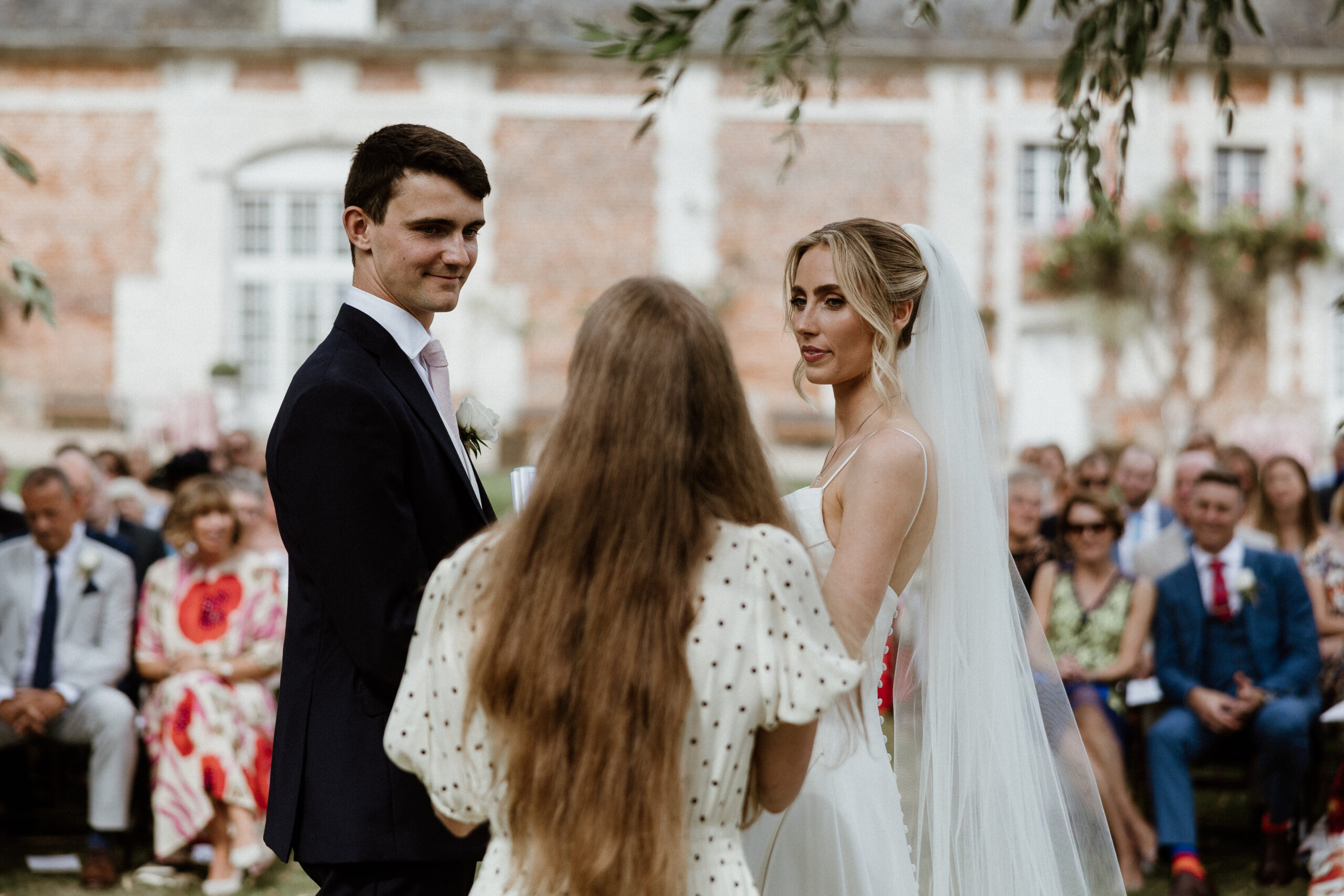
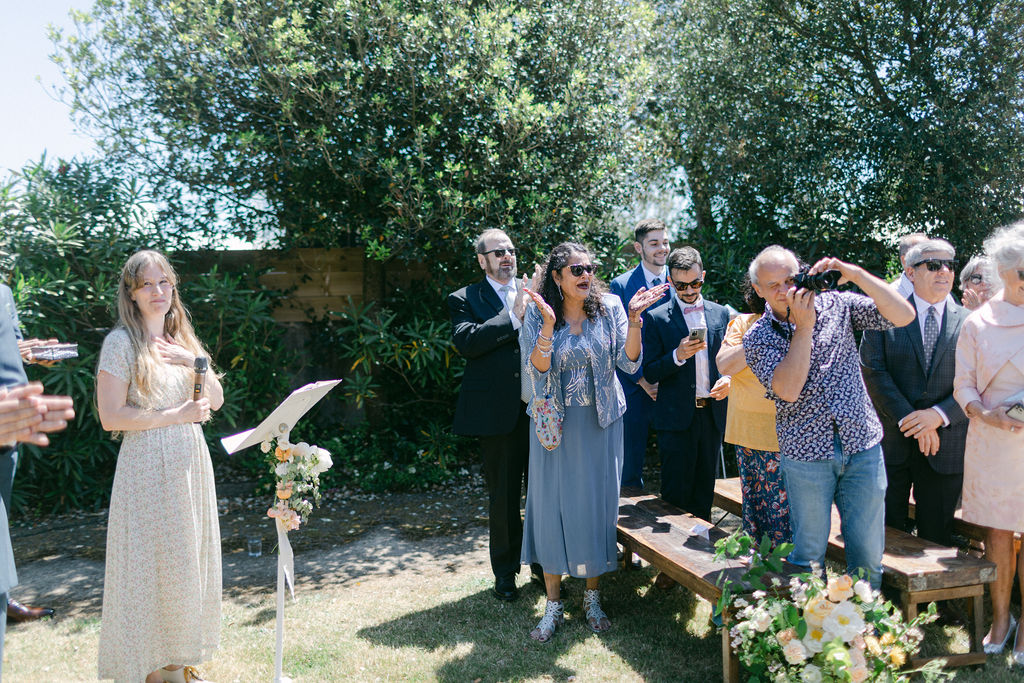
My aim is simple: for you – and in a lesser, although still significant way, your guests – to have the feeling that you are an integral part of the ceremony itself. That no one is a spectator, and everyone is a participant, even just through the act of listening.

To hear words that feel as though they belong to you.

To recognise yourselves in your own ceremony.


Inclusivity

Inclusive is a great word and one that’s used a lot at the moment. What I mean when I say that I create inclusive ceremonies, is that I don’t care what sex/non-binary/genre, colour, ability, orientation in any sense, age or nationality my couples (and very occasionally, and delightfully, triples) are. There are so many ways to be different from one another, and that’s fantastic. All that matters to me is that my couples are hung up on romancing, as one deliciously unusual and unclassifiable creature put it. So if you’re a couple of kooks looking for a multilingual celebrant in France to join you in symbolic, eccentric, gorgeous matrimony, I’m your girl! (Unfortunately I can’t provide Bowie himself but you could always walk down the aisle to him. Type-thing.)

Non-traditional French or Francophile couples:

Outrageous, totally original French writer Colette and her 15-years-younger lover, Maurice Goudeket … and previously, her Missy, and Natalie Barney, amongst so many others 

Sylvia Beach and her great love, Adrienne Monnier, both translators, publishers and founders of ground-breaking Parisian bookshops 

American writer and inveterate Wort-salade-ist Gertrude Stein, and her bidie-in, Alice B. Toklas, who cooked really weird meals, though perhaps no one ate them

George Sand and Chopin (whatever their relationship was) 

The unfortunate trio of Verlaine, Rimbaud, and absinthe 

Spectacular philosopher and feminist, Simone de Beauvoir, and café-skulker Jean-Paul Sartre 

Whatever you think of Emmanuel Macron, it is undeniable that his relationship with Brigitte Macron – née Trogneux, and current Présidente of La Fondation des Hôpitaux in Paris – is non-traditional in the sense that she was his French teacher when he met her as a schoolboy, and that he’s twenty-two years younger than her. Gloriously, they still seem absolutely besotted with each other  

and so on and so on and so on. France is unofficially very welcoming to non-conventional coupling.

NB. I don’t know if Colette ever loved anyone as much as her cats, though. 

NBB. Nobody has ever asked me to marry them to their moggy.


Reviews

  • “Thank you so much for yesterday, Stephanie!!! I need to tell you that all the guests LOVED it and kept asking us if we knew you personally, since the ceremony was so personal. They also were very impressed with the flow and the smooth switching between languages. It all went above and beyond my expectations, thank you so much from the bottom of my heart!!”

    Anna, bride
  •  La cérémonie de Stéphanie était tout simplement magnifique et le jonglage entre les langues était parfait.

    Sabine, franco-allemande et mère de la mariée
  • “I don’t know how you did it, but you somehow captured *them*”

    Mamta, mother of the bride
  • “Dear Stephanie, thank you so much for all of the hard work and attention you put into our wedding. We loved working with you and had an absolutely beautiful wedding thanks to you. Sending you lots of love.”

    Shannon and Arthur
  • "It was incredible! It was more than incredible!"

    Johannes, German dad of the bride, just after a trilingual ceremony in German, Brazilian Portuguese and English. Followed by a big hug.